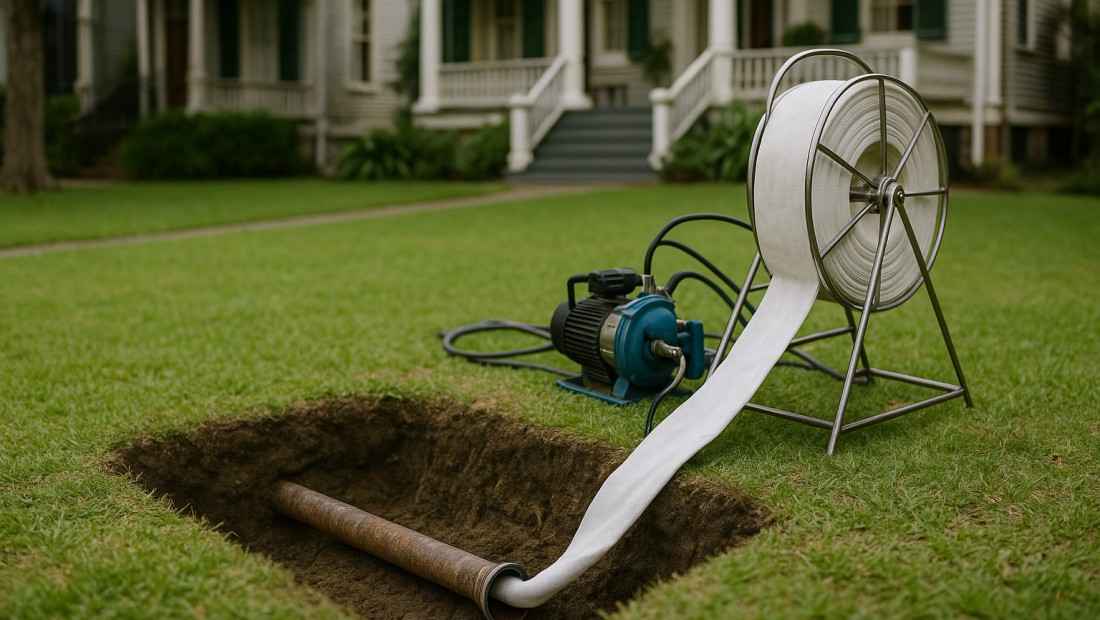
For most of plumbing history, fixing a broken sewer line meant digging a trench the length of the pipe — tearing up yards, driveways, courtyards, and sometimes slabs to reach a pipe buried several feet down. Trenchless repair changed that. Using one or two small access points, a pro can reline or replace a failing lateral with little or no excavation, which is an enormous advantage on the tight, historic, tree-filled lots that make up so much of New Orleans.
The two main trenchless methods
Trenchless sewer work generally comes down to two techniques, chosen based on the pipe’s condition:
- Cured-in-place pipe (CIPP) lining. A resin-saturated felt or fiberglass liner is pulled or inverted into the existing pipe and inflated, then cured (hardened) in place. The result is a new, seamless, jointless pipe formed inside the old one — ideal for sealing cracks, leaks, and root entry points in a pipe that’s damaged but not collapsed.
- Pipe bursting. A bursting head is pulled through the old pipe, fracturing it outward while simultaneously drawing a new pipe into the same path. This fully replaces the line — the right choice when the existing pipe is collapsed, badly bellied, or too deteriorated to line.
Why trenchless fits New Orleans
The case for trenchless is especially strong here. Historic neighborhoods are dense, with laterals running under mature live oaks, brick courtyards, slate walks, raised foundations, and homes set close to the lot line — all things you’d rather not excavate. Open-trench replacement on a Garden District or French Quarter lot can mean destroying landscaping and hardscape that’s as old as the house. Trenchless methods reach the same pipe through a single access pit (and sometimes a second), preserving the surface above. They also tend to be faster, getting a household back to normal in a day or two rather than a week of open excavation.
The trenchless process, step by step
- Inspect and locate. A camera shows the damage and a locator marks its exact position and depth, so the crew knows precisely what they’re dealing with.
- Clean the line. The pipe is jetted and root-cut so the liner bonds properly or the bursting head runs clean.
- Access. One or two small pits are dug at the access points — typically at the cleanout and near the connection — rather than along the whole run.
- Line or burst. The CIPP liner is installed and cured, or the bursting head pulls a new pipe through.
- Verify. A final camera pass confirms the new pipe is sound, continuous, and properly connected.
How trenchless compares on cost
Per foot of pipe, trenchless materials and equipment can cost more than plain pipe in an open trench. But the total project cost often favors trenchless once you account for what you’re not doing: no tearing out and rebuilding driveways, courtyards, mature landscaping, or interior slabs, and far less labor moving earth. On a New Orleans lot where the surface above the pipe is valuable and hard to restore, trenchless frequently comes out ahead overall — and the restored line, being seamless, resists the roots and infiltration that plague the old jointed pipe it replaced.
How long does a trenchless repair last?
A quality CIPP liner or a bursting-installed pipe is rated for many decades — commonly cited at 50 years or more — and because the new interior is seamless and jointless, it removes the very entry points that let roots and groundwater in. That longevity is a real advantage in New Orleans: replacing an old jointed clay lateral with a continuous modern pipe doesn’t just fix today’s break, it ends the root-intrusion cycle that would otherwise keep recurring.