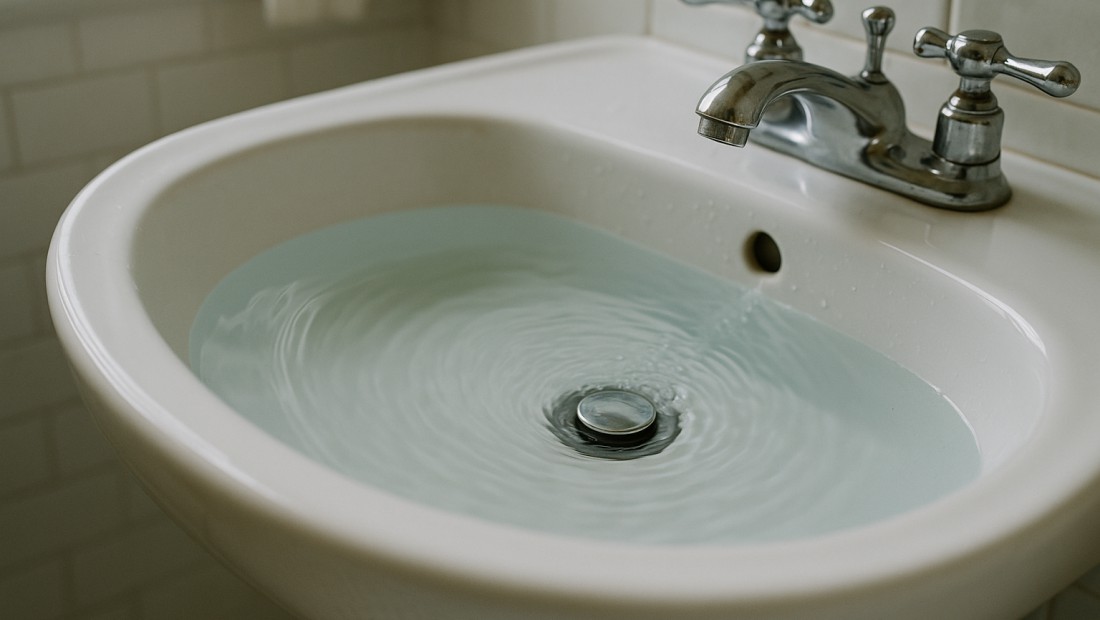
A slow drain is the most common early warning a plumbing system gives, and the easiest to ignore. Water that used to disappear in seconds now circles for half a minute; a tub leaves a shallow pool around your feet. It’s tempting to live with it, but a slow drain is buildup in progress — and in New Orleans’ flat, grease- and root-prone lines, “slow” has a way of becoming “stopped” without much notice.
What “slow” actually means
A drain is slow because something is narrowing the pipe. The water still gets through, just not at full speed, which means the blockage is partial. What’s narrowing it depends on the fixture: in a bathroom, it’s hair and soap scum near the drain; in a kitchen, it’s grease coating the line; in any old New Orleans pipe, it can be scale on a rough cast-iron interior. A partial blockage is the easiest kind to clear and the cheapest to deal with — which is exactly why catching a drain while it’s merely slow is worth doing.
One slow drain vs. several
Apply the key question right away: is it just this fixture, or others too?
- One slow drain, everything else fine. A local clog in that fixture’s trap or branch line. Low urgency, usually an easy clear. Try a hair catcher, clean the stopper, and if needed have the trap augered.
- Several drains slow together. The restriction is downstream where they share a line. Higher urgency — this is a branch or main-line issue building toward a backup, not a collection of coincidental clogs.
- Slow drains plus gurgling or odor. Often a venting problem or a more significant main-line restriction. Worth a closer look.
What you can try first
- Check the stopper and strainer. A shocking number of slow tubs and sinks are just a stopper mechanism wrapped in hair. Pull it and clean it.
- Try a plunger on a single slow fixture — a good seal and firm plunges can dislodge a soft local clog.
- Skip the chemical cleaner, especially in older homes; it can corrode old cast iron and rarely clears a clog fully.
- Note the pattern. If clearing the stopper and plunging don’t hold, or if other fixtures are involved, it’s time for a pro to auger the line or look deeper.
When a slow drain is actually the main line
Here’s the trap to avoid: assuming a slow drain is always local. If your lowest fixtures — a ground-floor tub, a floor drain — are the ones slowing down, or if running one fixture makes another slow or gurgle, the restriction is in the main, and the slow drain is just the first symptom. Treating that as a simple clog wastes money on repeated clearings while the real problem (roots, a belly, grease in the lateral) keeps growing. The tell is always the same: more than one fixture, or the lowest fixtures first.
From slow to fixed
For a genuinely local slow drain, augering the trap and branch restores full flow and you’re done. For a kitchen line slowed by grease or a lateral slowed by roots or scale, clearing it is temporary and jetting is the lasting clean. And for a chronically slow line across multiple fixtures, a camera inspection is the move — it shows whether you’re looking at buildup that jetting will solve or a defect that needs repair. The principle holds throughout: a slow drain is the cheapest version of the problem to solve, so the time to act is while it’s still just slow.