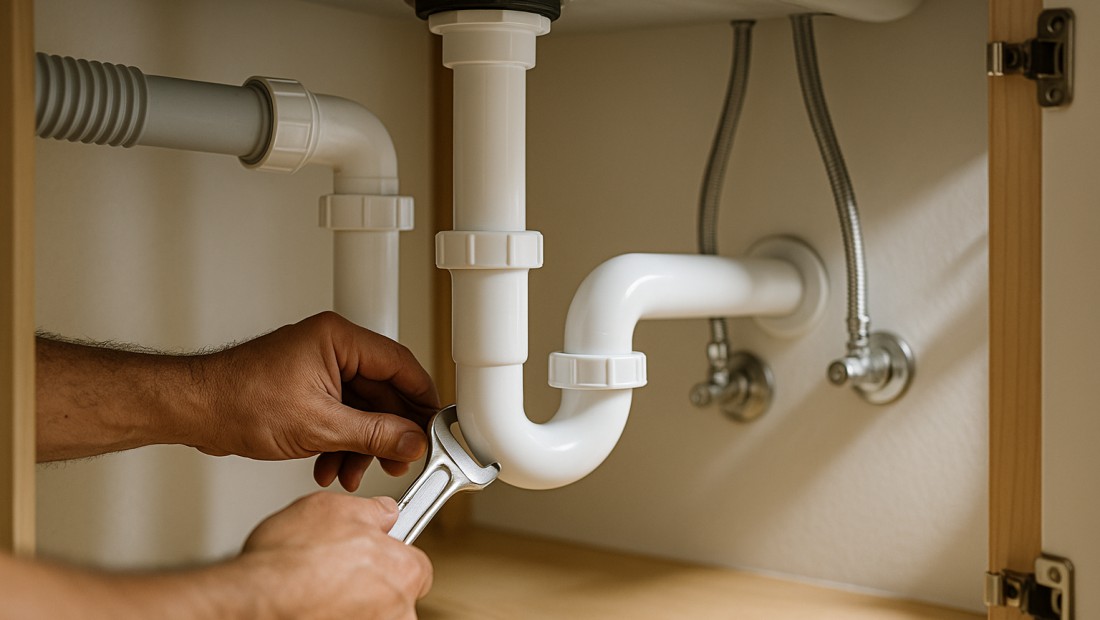
If there’s one drain that clogs more than any other in New Orleans, it’s the kitchen sink — and the reason is grease. In a city built around roux, fried seafood, and Sunday gravies, an enormous amount of fat goes down kitchen drains, and fat is the single most reliable way to clog a pipe. Clearing a greasy kitchen line takes the right method, and keeping it clear takes a few habits.
Why grease is the New Orleans kitchen’s nemesis
Hot grease goes down the drain as a liquid and seems harmless. A few feet into the pipe, it cools, congeals, and sticks to the walls. Every subsequent rinse adds another layer, and the pipe’s diameter shrinks like an artery until water can barely squeeze through. Food particles, coffee grounds, and starches from pasta and rice catch on the greasy walls and accelerate the process. Because New Orleans kitchen lines often run nearly flat with little slope to help carry waste along, the grease has every opportunity to settle and build rather than wash through.
This is why a kitchen drain that’s been “a little slow” for months can clog completely overnight, and why pouring boiling water or chemical cleaner down it gives only brief relief — those soften the surface of the grease without removing the layers underneath.
How a pro clears a greasy kitchen line
- Assess the clog. The tech checks whether it’s a local clog at the trap or P-trap, or a buildup deeper in the branch line serving the kitchen.
- Cable for a quick clear. A small drain machine can break through a localized grease plug and restore flow fast.
- Jet for a real clean. For a line caked with grease, hydro jetting is the difference-maker — high-pressure water emulsifies and flushes the fat off the pipe walls, restoring the full diameter instead of boring a channel through the sludge.
- Check the run. If the kitchen ties into a longer line shared with other fixtures, the pro confirms the clog isn’t deeper, in the building drain.
Keeping grease out: habits that actually work
- Never pour grease, oil, or fat down the drain — not even hot, not even “just a little.” Pour it into a can or jar, let it solidify, and throw it away.
- Wipe greasy pans with a paper towel before washing.
- Scrape plates into the trash, not the disposal — a garbage disposal grinds food but doesn’t change the fact that the slurry still has to travel a flat, grease-coated pipe.
- Run plenty of cold water while using the disposal and for a few seconds after, to carry particles along.
- Skip the fibrous and starchy stuff — onion skins, celery, coffee grounds, pasta, and rice are notorious for combining with grease into a cement-like plug.
Garbage disposals and the New Orleans line
A disposal is convenient, but it can lull you into sending more down the drain than a flat, aging pipe can handle. The disposal protects the trap from large chunks; it does nothing for the grease and starch that coat the pipe downstream. If your home has a disposal and a history of kitchen clogs, the fix isn’t a bigger disposal — it’s less food down the drain and a periodic jetting to keep the line scoured.
What kitchen drain cleaning costs
A straightforward kitchen-sink clog cleared by cabling is one of the more affordable drain jobs. Hydro jetting a greasy kitchen branch costs more but does far more, and for a chronically slow line it’s usually the better value because it postpones the next clog by years rather than weeks. Price climbs if the clog turns out to be deeper than the kitchen branch — in the building drain or main — which a camera can confirm. As always, an accessible cleanout makes the work faster and cheaper.
When the kitchen clog is really a main-line problem
Most kitchen clogs are confined to the kitchen branch. But if clearing the kitchen line doesn’t hold, or if other fixtures act up when you run the kitchen sink, the real blockage may be downstream where the kitchen line joins the main. That’s a different (and more important) problem, and it’s worth a camera inspection rather than repeated trips to clear the same sink.