What Your Drains Are Telling You
Drains rarely fail without warning. This plain-language guide decodes the early signs — slow drains, gurgles, odors, recurring clogs — so you know what’s wrong and how urgent it is.
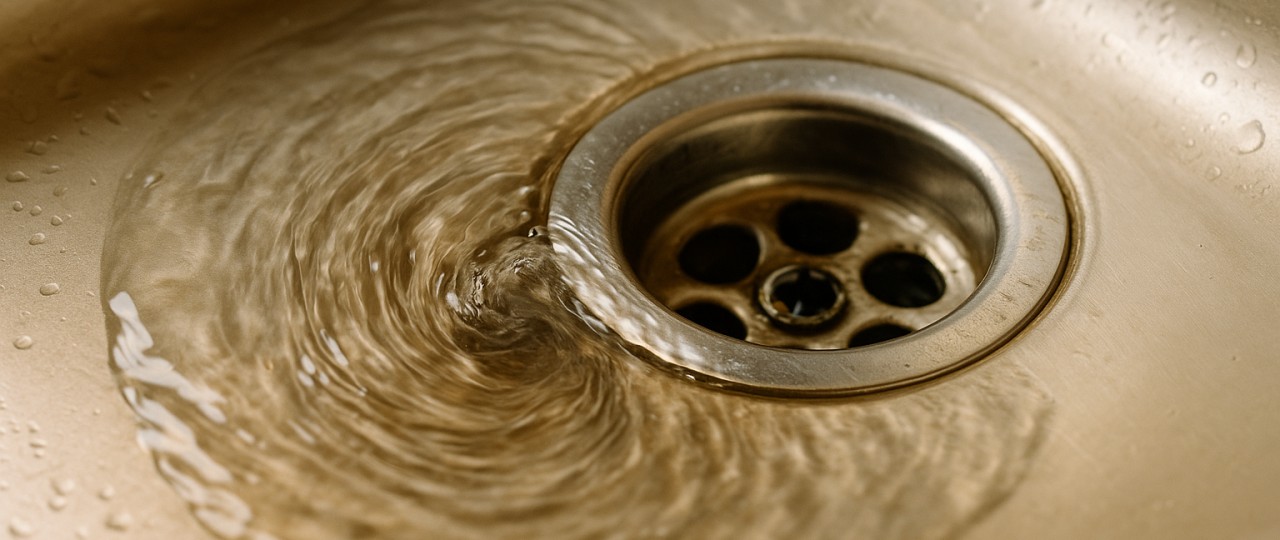
Drains rarely fail without warning. Long before a line backs up, it usually tells you something is wrong — a sink that empties slower than it used to, a gurgle after the washing machine drains, a whiff of sewer near a floor drain. Learning to read those early signs is the difference between scheduling a routine cleaning and mopping up a 2 a.m. backup. This section is a plain-language guide to what your drains are trying to tell you.
Each symptom below points toward a likely cause, and — just as important — tells you whether it’s a single-fixture problem you can keep an eye on or a main-line warning worth acting on now. None of this replaces a camera inspection when one is warranted, but it will help you describe the problem accurately and know how urgent it is.
The one question that sorts most drain problems
Before anything else, ask: is it one fixture or several? A single slow or clogged drain, with everything else in the house working normally, is almost always a local clog in that fixture’s trap or branch — annoying but contained. Two or more fixtures acting up together, especially ones in different rooms, means the problem is downstream where they share a line, and possibly in the main. That single distinction tells you most of what you need to know about how serious a symptom is.
Decode the symptom
Five of the most common warning signs, what each one usually means, and whether it’s a local clog or a main-line problem.
Slow-Draining Sink or Tub
The most common early warning. What a slow drain means, when it’s local, and when it points to something bigger.
Learn more →Gurgling Drains
That glug after you flush or drain the washer is air escaping a restricted line — often a venting or main-line clue.
Learn more →Sewer Smell in the House
A sewer-gas odor indoors usually means a dry trap or a venting problem — sometimes a blockage. How to track it down.
Learn more →Clogs That Keep Coming Back
When the same drain clogs again and again, snaking isn’t the answer. The real causes — and the real fix.
Learn more →Multiple Drains Backing Up
Several fixtures failing at once is the clearest sign of a main-line problem. Why it happens and what to do.
Learn more →Frequently asked questions
How do I know if a drain problem is serious?
The biggest factor is how many fixtures are affected. One slow drain with everything else working is usually a local, low-urgency clog. Two or more fixtures backing up or gurgling together — especially in different rooms — points to a main-line problem that should be handled promptly before it becomes a full backup.
Can I diagnose a drain problem myself?
You can get a good way toward it by noticing patterns: which fixtures, whether they affect each other, whether it’s tied to rain, and whether it keeps returning. That tells you how urgent it is and helps you describe it accurately. A camera inspection is what confirms the cause inside the pipe when the symptoms warrant it.
When should I stop troubleshooting and call someone?
Right away if you see or smell sewage, if more than one fixture backs up, if a backup happens during rain, or if water rises in one fixture when you use another. Those are main-line signs that home tools can’t reach. A single slow drain you can usually try a hair catcher and a plunger on first.
Why does the same drain keep clogging?
Recurring clogs in one spot mean buildup or a defect that snaking only temporarily relieves — grease coating the walls, roots at a joint, a low spot where waste settles, or an old scaled pipe. The cure isn’t repeated cabling; it’s finding the cause with a camera and addressing it with jetting or a repair.
A drain backing up doesn’t wait. Neither do we.
In a city this far below sea level, a slow drain can become a backup overnight. Get matched with a licensed New Orleans pro for a free assessment — day or night.