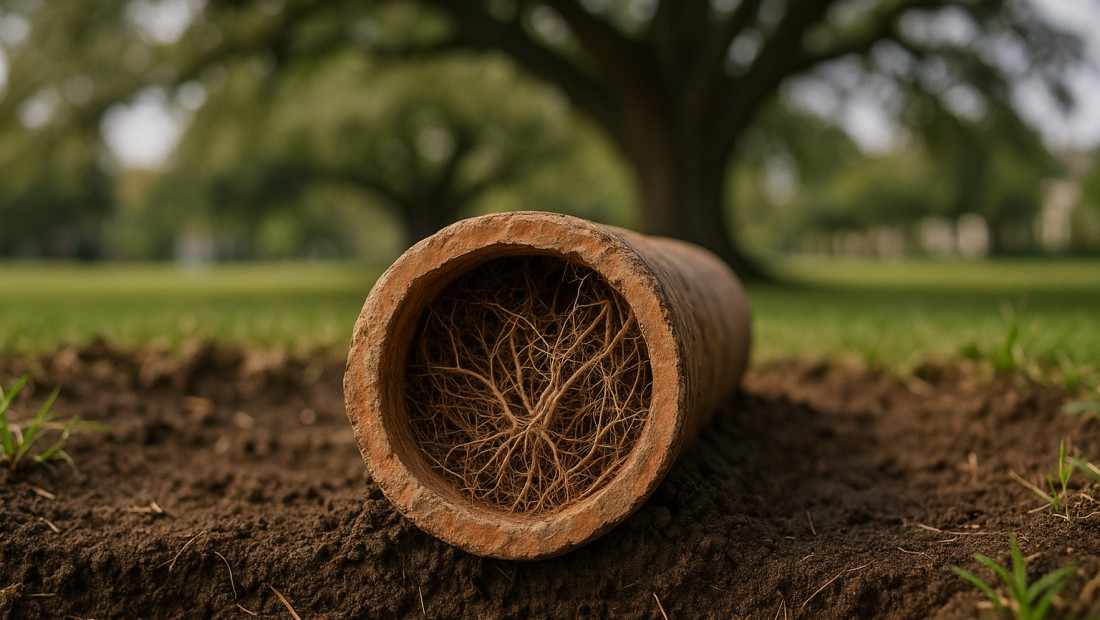
If there is one thing that defines New Orleans sewer problems, it’s roots. The same live oaks that arch over St. Charles Avenue and shade the Garden District send their roots reaching for the water and nutrients inside sewer pipes, and once they find a joint in an old clay or cast-iron lateral, they move in and don’t leave. Root intrusion is the single most common cause of recurring backups in the city’s older neighborhoods.
How roots get into a sewer line
Roots don’t break into sound, sealed pipe — they exploit weakness. A tiny gap at a pipe joint, a hairline crack, or a loose connection leaks a trace of moisture and nutrients into the surrounding soil. To a tree, that’s a signal. Fine root hairs grow toward the leak, slip through the opening, and then flourish inside the pipe, where conditions are ideal. What started as a thread becomes a dense mat that catches grease, paper, and solids flowing by, gradually choking the line until it backs up. Because the roots re-grow, the problem is chronic: cable it clear and the line flows again, but the roots return.
Clearing roots: cutting and jetting
- Camera first. An inspection shows where the roots are entering and how far they’ve spread — and whether the pipe around the intrusion is intact or failing.
- Mechanical cutting. A cable with a rotating cutting head shears the root mass back to the pipe wall, restoring flow quickly.
- Hydro jetting. A root-cutting jetter nozzle cuts and flushes the finer roots and clears the debris, leaving the pipe cleaner than cabling alone.
- Verify and plan. A post-clearing camera pass confirms the result and helps set a maintenance interval or a repair decision.
Cutting roots vs. fixing the entry point
Here’s the honest truth about roots: cutting them is treatment, not cure. As long as the gap that let them in remains, the roots will grow back — typically within months to a couple of years, depending on the tree and the season. There are really three ways forward, and the right one depends on the line:
- Manage them. For a line that’s otherwise sound with one modest entry point, scheduled cutting or jetting on a regular interval keeps roots from ever building up enough to block the line. Often the most economical choice.
- Repair the entry. A spot repair or trenchless lining at the offending joint seals the opening so roots can’t get back in, ending the cycle for that section.
- Reline or replace. For a lateral with multiple entry points and general deterioration, lining the whole pipe (or replacing it) creates a continuous, jointless interior that roots can’t penetrate.
What about chemical root treatments?
Foaming root-killing products marketed for sewer lines can slow regrowth at the pipe wall, and a pro may apply a professional-grade foam after mechanical cutting to extend the time between cleanings. They’re a supplement, not a solution — they don’t remove an established mat or seal the entry point, and homeowner pour-down products rarely reach or coat the intrusion effectively. The reliable path is mechanical removal plus a decision about managing or repairing the entry.
Do I have to remove the tree?
Usually not — and in New Orleans, where mature trees are protected and prized, removal is rarely the first answer. Sealing the pipe so roots can’t enter (lining or spot repair) lets you keep the tree and end the intrusion. Removing a tree is a last resort for cases where a specific tree is repeatedly destroying a line and repair isn’t viable, and even then the existing roots can keep growing for a time. The pipe-side fix is almost always the better path.
What root removal costs
A straightforward root cutting or jetting through an accessible cleanout is a moderate, routine job. Costs rise with the severity of the intrusion, whether jetting is needed in addition to cutting, and access. Where the real decision lies is the long game: paying to cut the same roots two or three times a year adds up, and at some point sealing the entry point with a trenchless repair becomes the cheaper option. A camera inspection is what lets you make that call with real information rather than guesswork.