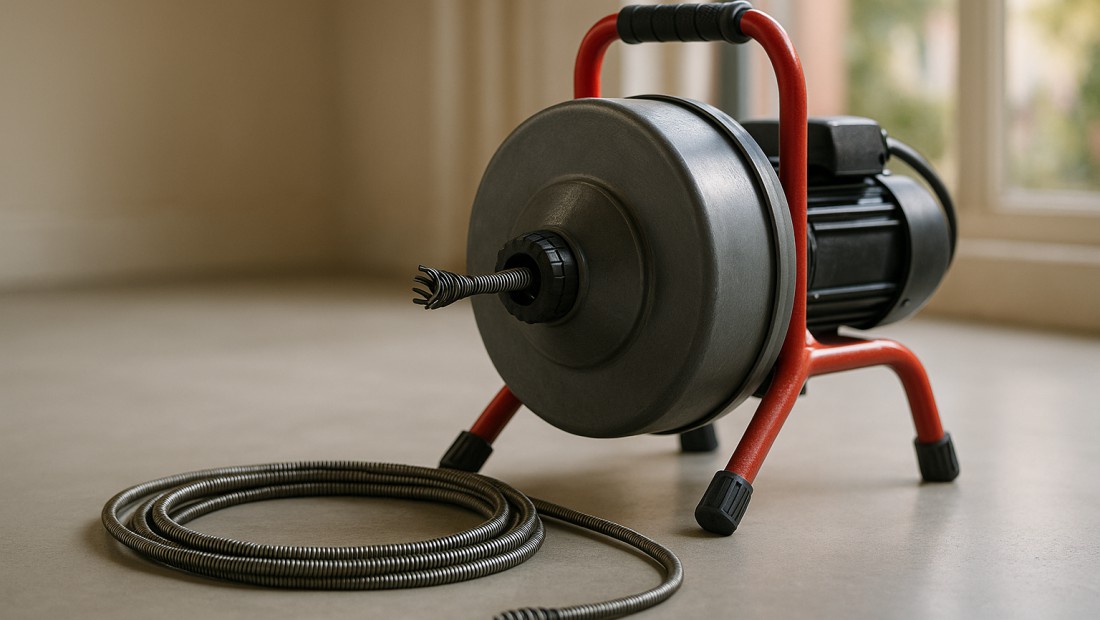
Drain snaking — also called cabling or rodding — is the workhorse of drain cleaning. It’s fast, affordable, and the right first response for the great majority of household clogs. Understanding what it does well, and where it falls short, helps you know when a quick snake is all you need and when the line is asking for more.
What snaking actually does
A drain snake is a flexible steel cable, hand-cranked for small jobs or driven by a motor for larger ones, fed down the pipe until it reaches the blockage. A head on the end — a corkscrew tip for grabbing, a blade for cutting — breaks through the clog or hooks it so the tech can pull it back out. For a hair mass in a shower, a wad of debris in a sink line, or a localized obstruction in a branch, this is exactly the right tool: it removes the clog directly and gets water moving again in minutes.
When snaking is the right choice
- A single slow or clogged fixture — one shower, one sink, one tub — where the blockage is local.
- A solid obstruction like a hair clog, a stuck object, or a wad of debris that can be physically removed.
- A quick, affordable clearing when you need flow restored now and the line is otherwise healthy.
- A first response before deciding whether deeper cleaning or a camera look is warranted.
Where snaking falls short
Cabling clears a path through a blockage, but it doesn’t clean the pipe. On a greasy kitchen line, the cable bores a hole through the grease and leaves the coated walls behind — so the clog reforms. On a root intrusion, a cutting head shears off the roots in the pipe but leaves the root mass at the joint to regrow. On a line caked with scale or sludge, snaking offers only temporary relief. In all of these cases, the lasting fix is hydro jetting, which removes the buildup rather than punching through it. The rule of thumb: if a line clogs once, snake it; if it clogs again, find out why.
Snaking and old New Orleans pipes
The historic housing stock here calls for a careful hand. Brittle old clay and corroded cast-iron laterals can be damaged by an aggressive cable, and a snake driven hard into a pipe that’s already cracked or offset at a joint can make matters worse. An experienced local pro reads the resistance, knows when a line feels like it has roots or a structural defect rather than a simple clog, and recommends a camera look instead of forcing the cable. Snaking is gentle and effective on a sound line; on a failing one, it’s a diagnostic clue.
What snaking costs
Cabling a single accessible drain is one of the most affordable plumbing services there is, which is part of why it’s the default first move. Cost rises modestly for a main-line clearing through a cleanout, and more if there’s no cleanout and the tech has to access the line another way. Because snaking is inexpensive, it’s easy to fall into a pattern of repeated snakings on a line that really needs jetting or repair — if you’ve had the same drain cabled more than once or twice, the math usually favors finding the cause.
How to know when snaking isn’t enough
A few signs tell you a clog needs more than a cable: it returns within weeks or months, it affects more than one fixture, the cable pulls back roots or grease, or it’s in an old line you suspect is failing. In any of these cases, the next step isn’t another snaking — it’s a camera inspection to see the pipe and a decision about jetting or repair. Snaking is the right tool for a clog; it’s the wrong tool for a problem.