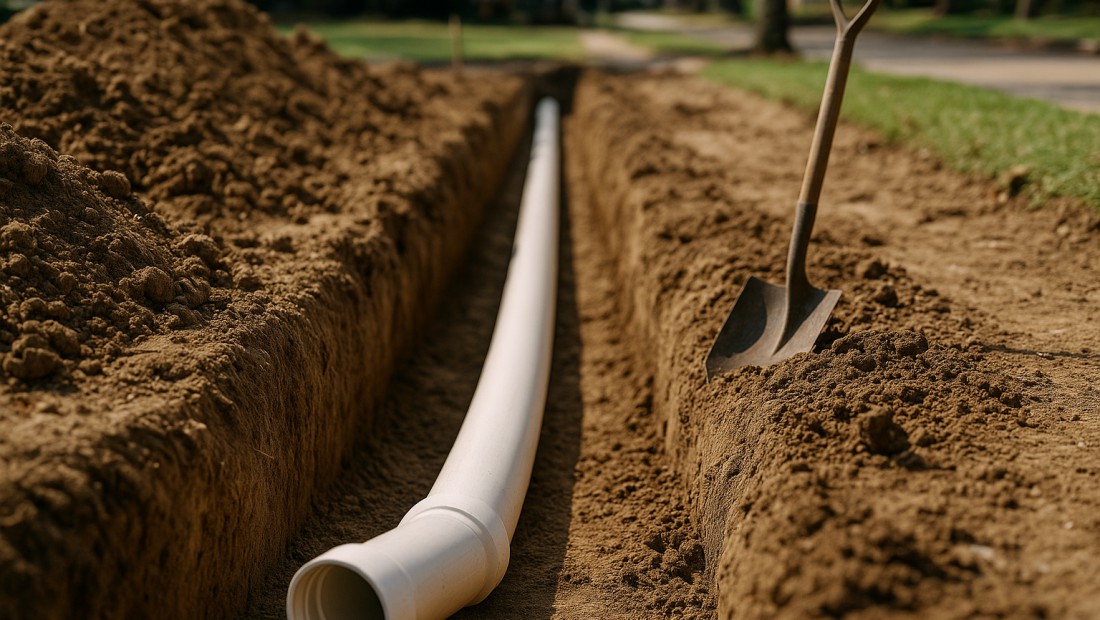
Sometimes a sewer line is past the point of cleaning or patching. When a lateral has collapsed, deteriorated along its whole length, or sagged into a belly that no amount of jetting will fix, replacement is the honest answer. The good news is that “replacement” in New Orleans no longer always means a backhoe and a week-long trench across your yard — trenchless options have changed what replacement looks like.
When a line needs replacing, not repairing
A camera inspection is what separates a line that can be cleaned or spot-repaired from one that needs to be replaced. The signs that point to replacement:
- Collapse. A section that has caved in blocks flow completely and can’t be cleared — the pipe is gone.
- Widespread deterioration. An old cast-iron line scaled and corroded along its length, or an Orangeburg pipe that has gone soft and oval, is failing everywhere, not in one spot.
- Multiple breaks or offsets. When a line has separated or cracked in several places, patching each one costs more than replacing the run.
- A significant belly. A deep sag where the pipe has lost its slope traps waste permanently; the section has to be re-laid to restore proper fall.
- Repeated failure. A line you keep paying to clear, that keeps backing up, is often cheaper to replace than to keep nursing.
Trenchless vs. open-trench replacement
There are two ways to replace a lateral, and the choice depends on the pipe’s condition and the site:
- Trenchless replacement (pipe bursting) pulls a new pipe through the old one’s path while fracturing the old pipe outward, using just access pits at each end. It’s the preferred method when the path is suitable, because it spares yards, courtyards, driveways, and trees.
- Open-trench (conventional) replacement excavates the line and lays new pipe directly. It’s necessary when the old line is too collapsed or misaligned to burst, when grade has to be re-established (as with a deep belly), or when the layout doesn’t allow a clear bursting path.
What replacement involves
- Inspect, locate, and plan. A camera and locator map the line, its depth, and its connections, and the pro determines whether trenchless or open-trench is appropriate.
- Permitting. Sewer lateral work in New Orleans is regulated; a licensed plumber pulls the required permits and coordinates with local authorities and any required inspections.
- Access or excavation. Either access pits for bursting or an open trench along the run.
- Install the new line. New pipe is laid or pulled through at the correct slope and connected to the building drain and the public main.
- Inspect and restore. A final camera pass verifies the new line, then the access points or trench are backfilled and the surface restored.
What sewer line replacement costs
Replacement is the largest sewer expense — a four-to-five-figure project depending on the length and depth of the line, the method, site conditions, and how much surface restoration is involved. Depth matters a lot in New Orleans, where a high water table can mean shoring and dewatering an open trench. Trenchless bursting often reduces the total despite higher per-foot cost, because it eliminates most restoration. Because the numbers are significant, this is exactly the situation where a camera inspection and a clear, itemized scope — ideally a couple of quotes — are worth getting before committing.
Getting it done right
A sewer replacement is permitted, code-regulated work that ties into the public system, so it has to be done by a licensed plumber, not a handyman. Insist on a camera inspection that you can see, a written scope that specifies the method and the slope correction, and verification (a final camera pass) when it’s done. A line replaced properly — continuous modern pipe at the correct fall — should outlast the rest of the plumbing and put an end to the root and backup problems that prompted it. We’re a referral service, not a contractor, so we’ll connect you with licensed local pros and leave the choice, and the verification, in your hands.