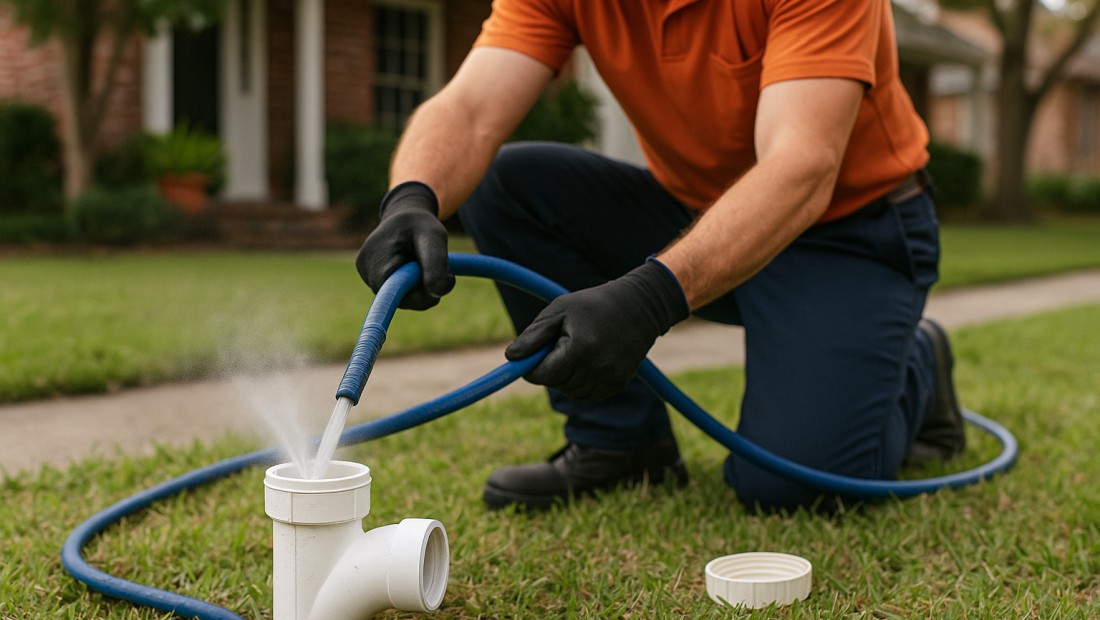
Sewer line cleaning is the maintenance that keeps the lateral — the main pipe carrying everything from your home to the street — flowing freely. It’s different from clearing a clog in a single drain: this is the whole-house artery, and in New Orleans it’s working against roots, grease, scale, and the flat grades that let waste settle. Cleaning it properly means more than punching through the latest blockage.
Cleaning vs. clearing
Clearing a stoppage gets water moving again. Cleaning the line removes the buildup that caused the stoppage and would cause the next one. The distinction matters most on a sewer lateral, because the things that block it — grease films, sediment in low spots, scale on old pipe walls, root hair at joints — are progressive. Cabling bores a temporary channel through them; a thorough cleaning, usually by hydro jetting, scours the pipe back toward its original diameter so it stays clear far longer.
How a sewer line gets cleaned
- Access through the cleanout. Work is done through the lateral’s cleanout so the equipment reaches the full run of pipe without disturbing the house.
- Clear any active blockage. If the line is stopped, a cable or jetter first restores basic flow.
- Cut roots if present. A cutting head or root-cutting jetter nozzle shears back root intrusion at the joints.
- Jet the full line. High-pressure water scours grease, sludge, and scale off the pipe walls along the entire lateral.
- Camera-verify. A post-cleaning camera pass confirms the line is genuinely clean and reveals any defects that were hidden under the buildup.
Why New Orleans laterals need cleaning more often
The same conditions that plague the city’s drains concentrate on the lateral. Flat grades mean waste moves slowly and sediment settles. The food culture pushes grease all the way to the main. Mature trees crowd root mats into every available joint. And old clay and cast-iron pipe has a rough, scaled interior that grabs everything passing by. Where a home in a newer subdivision might go decades without thinking about the lateral, a century-old New Orleans house often benefits from periodic cleaning — every year or two for root- or grease-prone lines — to head off backups before they happen.
Preventive cleaning and maintenance plans
For a lateral with a known issue that isn’t worth a full repair — say, modest root intrusion at one joint — a maintenance schedule is often the most economical path. Jetting the line on a regular interval keeps the roots cut back and the grease cleared before either can cause a backup. It’s the same logic as cleaning gutters before the storm rather than bailing water after: planned cleaning is cheaper and less disruptive than emergency clearing. A camera inspection establishes the right interval for your specific line.
What sewer line cleaning costs
Cleaning a lateral costs more than clearing a single drain because it involves the full length of the main pipe and usually hydro jetting rather than a quick cable. Cost depends on the length and diameter of the line, how much buildup or root intrusion is present, and access — an accessible cleanout keeps it efficient. When weighed against repeated emergency clearings of a chronically clogging line, periodic cleaning is generally the better value, both in money and in avoided 2 a.m. backups.