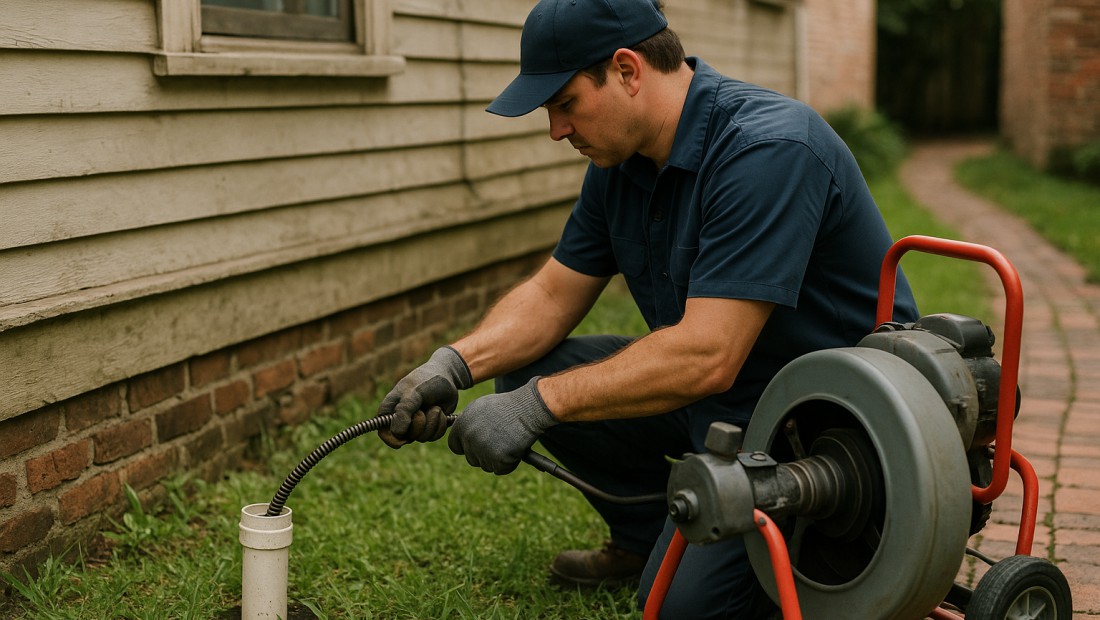
When a single drain clogs, you lose one fixture. When the main line stops, you lose the whole house — every sink, toilet, and tub feeds into that one pipe on its way out to the street. A main-line stoppage is the most disruptive drain problem there is, and in New Orleans’ flat, root-filled, century-old sewer network it’s also one of the most common.
How to tell it’s the main line
The tell-tale sign is more than one fixture failing together, especially fixtures that have nothing to do with each other. A clogged kitchen sink is a kitchen problem. A clogged kitchen sink and a gurgling downstairs toilet and a tub that backs up when you run the washing machine is a main-line problem — the blockage is downstream of all of them, in the building drain or the sewer lateral that carries everything to the public main.
A few classic patterns point to the main:
- Flush a toilet and a nearby tub or shower bubbles up — air and water are looking for an escape because the main is blocked.
- The lowest fixtures back up first — a ground-floor shower or floor drain floods while upstairs still drains, for now.
- Running one fixture affects another — the washing machine drains and the toilet rises.
- Everything is slow at once, not just one room.
Why New Orleans mains stop
The causes here are a product of the city’s age and geology. Live-oak and other tree roots seek out the moisture and nutrients inside sewer pipes and pry into the joints of old clay and cast-iron laterals, then grow into dense mats that catch everything passing by. Decades of grease and scale narrow the pipe walls. And the ground itself moves — New Orleans is subsiding, and as soil settles unevenly it bends laterals into low spots, or “bellies,” where waste and water pool and solids settle out instead of flowing through. Any one of these can take a main from “a little slow” to “completely stopped” with one ordinary flush.
How a main-line stoppage is cleared
- Find the cleanout. Mains are cleared through a cleanout — a capped access point on the lateral, usually outside near the foundation or at the property line. Working through it keeps the mess out of the house.
- Cable the line. A motorized drain machine feeds a heavy cable with a cutting head down the pipe to break through and pull back the blockage.
- Jet if needed. For grease, sludge, or root mats, hydro jetting scours the full diameter of the pipe clean rather than just boring a hole through the obstruction.
- Verify flow. The tech runs water and watches it move freely through the cleanout before calling the line clear.
- Camera the pipe. A video inspection shows what caused the stoppage and whether the line has roots, a belly, or a break that will bring it back.
What a main-line clearing costs
Clearing a main through an accessible cleanout is a moderate job, typically more than a simple sink clog but well short of a repair. Costs climb when there’s no cleanout, when the blockage is deep or stubborn, when jetting is required instead of cabling, or when it’s an after-hours emergency call. The honest truth is that price depends heavily on access and cause, which is why a camera inspection after the clearing is worth it — it tells you whether you’re looking at a one-time clearing or a line that needs ongoing maintenance or repair.
Clearing it vs. fixing it
Cabling restores flow. Whether the line stays clear depends entirely on why it stopped. A grease blockage cleared and followed by better habits may not return for years. A root intrusion will come back on a predictable schedule unless the line is jetted regularly or the offending section is repaired. A bellied or broken lateral will keep stopping no matter how often it’s cabled, because the defect is structural. The smart sequence is the same every time: clear the emergency, camera the line, then decide whether maintenance or a repair makes more sense for your home.