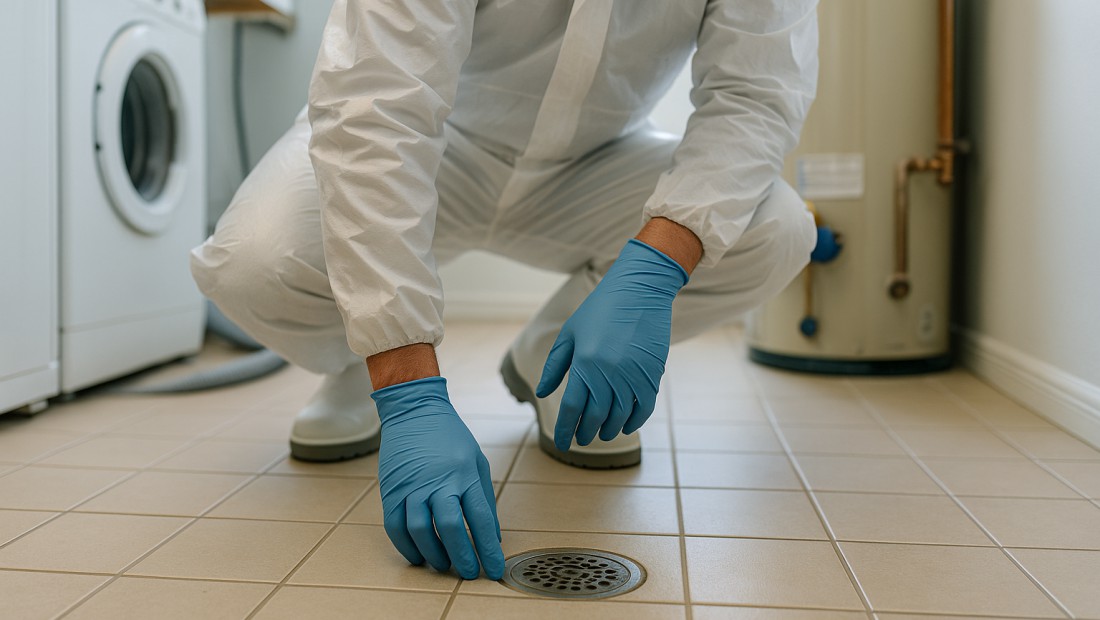
Few household problems are as alarming as sewage coming back up through a drain. It’s a health hazard, it’s a sign the main line is blocked, and in a low-lying, humid city like New Orleans it has to be handled fast before it soaks into flooring and walls. Here’s what’s happening, what to do in the first few minutes, and how a pro clears it.
Why sewage backs up into the house
When wastewater appears in a tub, shower, floor drain, or toilet that you didn’t just use, it means the path out of your home is blocked downstream of that fixture. Everything you send down a drain travels to a single building drain and then out through the sewer lateral to the public main. If that shared path is obstructed — by roots, grease, a collapsed section, or a surcharged public system during rain — the wastewater backs up and exits at the lowest, easiest opening it can find. That’s almost always a ground-floor tub or floor drain, which is why those fixtures flood first.
In New Orleans the usual suspects line up predictably. Roots from the city’s grand live oaks find their way into joints in old clay and cast-iron laterals. Grease from a food-loving city congeals in flat-running pipes. And during heavy rain, the public system can fill faster than it drains, pushing water back toward homes whose laterals connect low.
1) Stop using all water immediately. No flushing, no faucets, no washer or dishwasher.
2) Keep people and pets away — raw sewage carries bacteria and pathogens.
3) Don’t try to plunge a main-line backup; it won’t reach the blockage and can splash contaminated water.
4) If safe, shut off water to the affected fixtures and switch off power to any outlets near standing water.
5) Call a licensed pro. The faster the line is cleared, the less cleanup you face.
How a pro clears a sewage backup
- Confirm it’s the main. The tech checks whether multiple fixtures are affected, which points to a main-line stoppage rather than a single clogged drain.
- Access the line. Work is done through an exterior or interior cleanout so the blockage can be reached directly — the right access point keeps sewage out of your living space.
- Relieve the pressure. A cable or jetter breaks through the blockage, and standing wastewater drains back down and out.
- Clear it fully. The line is cabled or hydro-jetted to remove the obstruction completely, not just punch a hole through it.
- Inspect the cause. Once flow is restored, a camera shows whether roots, grease, or a broken section caused the backup — and whether it’s likely to recur.
Cleanup and what comes after
Clearing the line stops the source, but the contaminated water it left behind still has to be dealt with. Small backups confined to a hard-surface floor can often be cleaned and disinfected by the homeowner with proper gloves, a mask, and a diluted bleach solution. Larger backups, anything that soaked into drywall, carpet, or subfloor, or any backup involving black water (raw sewage) is a job for a professional cleanup crew — both for safety and because New Orleans humidity turns wet building materials into a mold problem within a day or two. A camera inspection afterward is strongly recommended; a backup serious enough to surface inside the home almost always has an underlying cause worth finding.
Health and contamination notes for New Orleans homes
Raw sewage is classified as Category 3 “black water” — it carries bacteria, viruses, and parasites, and it shouldn’t be treated like an ordinary spill. Porous materials that absorb it (carpet pad, drywall, particleboard) generally can’t be fully disinfected and should be removed. Keep the affected area ventilated, run a dehumidifier if you have one, and document everything with photos before cleanup in case you file an insurance claim. Many policies cover sudden sewer backup only if you’ve added a specific endorsement, so it’s worth checking your coverage before the next storm season.
Preventing the next one
A single backup can be bad luck; a pattern is a warning. If your home has backed up more than once, the fix isn’t repeated emergency cabling — it’s finding and correcting the cause. For root intrusion, that means jetting plus a maintenance schedule or a spot repair at the offending joint. For grease, it means jetting and better kitchen habits. For a bellied or broken lateral, it means a targeted or trenchless repair. A backwater valve, installed on the lateral, can also stop the public system from pushing water back into a low-connected home during heavy rain.