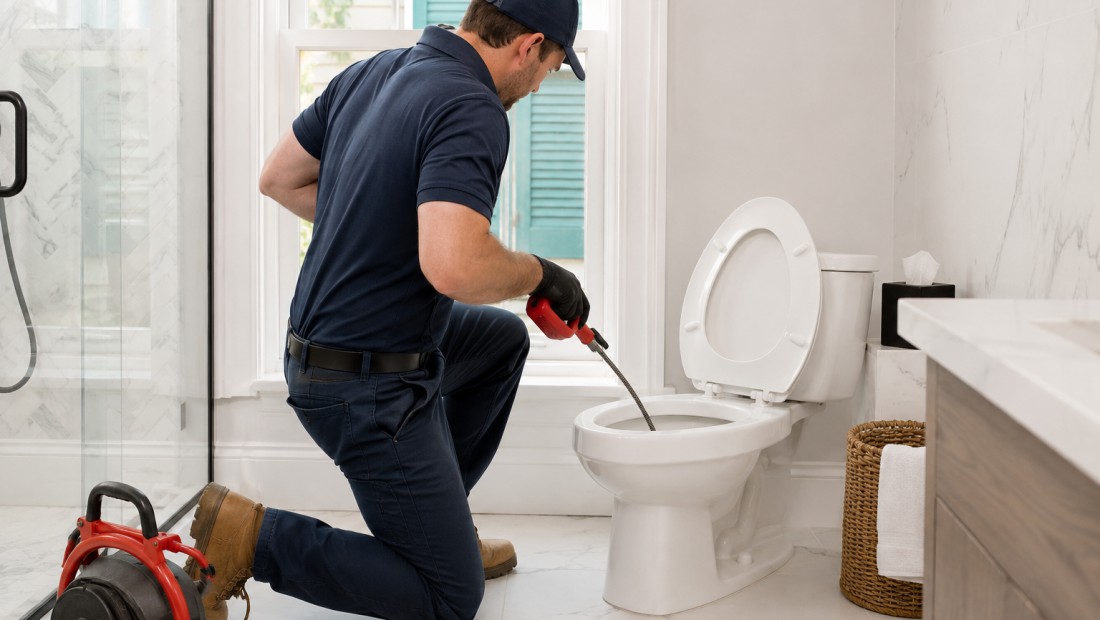
A toilet that won’t flush is one of those problems that goes from minor to urgent fast, especially in a home with only one bathroom. Most clogs clear with a plunger, but when they don’t — or when more than one toilet acts up — the blockage is past the bowl, and that’s a different problem worth understanding before it becomes a backup.
Where toilet clogs actually happen
A toilet can clog in three different places, and the location tells you how serious it is. The most common is right in the toilet’s own trap — the curved channel built into the porcelain — usually from too much paper, a flushed wipe, or a child’s toy. Next is the closet bend and the branch line just downstream, where a partial clog slows the flush. The most serious is the main line: if the blockage is there, the toilet is just the lowest, easiest place for the whole house’s wastewater to come back up.
What you can try before calling
- Use a proper flange plunger, the kind with an extended rubber sleeve that seals in the bowl outlet — not a flat sink plunger. Firm, steady plunges do far more than frantic ones.
- Don’t keep flushing a toilet that didn’t clear — you’ll only risk an overflow. One test flush after plunging is enough.
- Try a toilet auger (closet auger) if you have one — it’s designed to reach through the trap without scratching the porcelain.
- Skip the chemical drain cleaner. It’s ineffective on a toilet clog and creates a hazard of caustic water in the bowl.
How a pro clears a toilet clog
- Diagnose the location. The tech determines whether the clog is in the toilet trap, the branch line, or the main — which decides the whole approach.
- Clear a trap or branch clog. A closet auger reaches through the toilet trap; a small drain machine clears the branch just downstream if needed.
- Pull the toilet if necessary. For a stubborn object or a clog just past the toilet, removing and resetting the toilet gives clean access — and reveals anything lodged in the trap.
- Cable the main if the problem is downstream, working through a cleanout to clear the line that serves the whole house.
Wipes, “flushable” and otherwise
The single biggest change in toilet clogs over the past decade is wipes. So-called flushable wipes do not break down the way toilet paper does; they travel intact, snag on any roughness in the pipe, and combine with grease into the dense masses that plumbers across the country have started calling by an unprintable name. In New Orleans’ flat, often-scaled old lines, wipes are especially prone to hanging up. The rule is simple: nothing goes in the toilet but human waste and toilet paper. Wipes, paper towels, cotton, floss, and “flushable” anything belong in the trash.
Old toilets, old lines
Two things make toilet clogs more common in older New Orleans homes. First, vintage low-flow and pre-low-flow toilets sometimes lack the flush power to push waste through a flat branch line, so marginal clogs accumulate. Second, the branch and main lines those toilets feed are often old cast iron or clay, with rough, scaled interiors and root-prone joints that catch what passes by. If a toilet clogs repeatedly despite reasonable use, the toilet may be underpowered, the line may be compromised, or both — and a camera inspection is the way to tell.
What it costs
Clearing a simple toilet-trap clog is a quick, inexpensive job, and pulling and resetting a toilet to clear a stubborn obstruction is moderately more. The cost climbs when the problem turns out to be in the main line, which is a larger clearing through a cleanout, and more again if it’s an after-hours emergency. The reassuring part is that a true toilet clog — confined to the bowl’s trap or the branch — is among the most routine and affordable calls a drain pro handles.