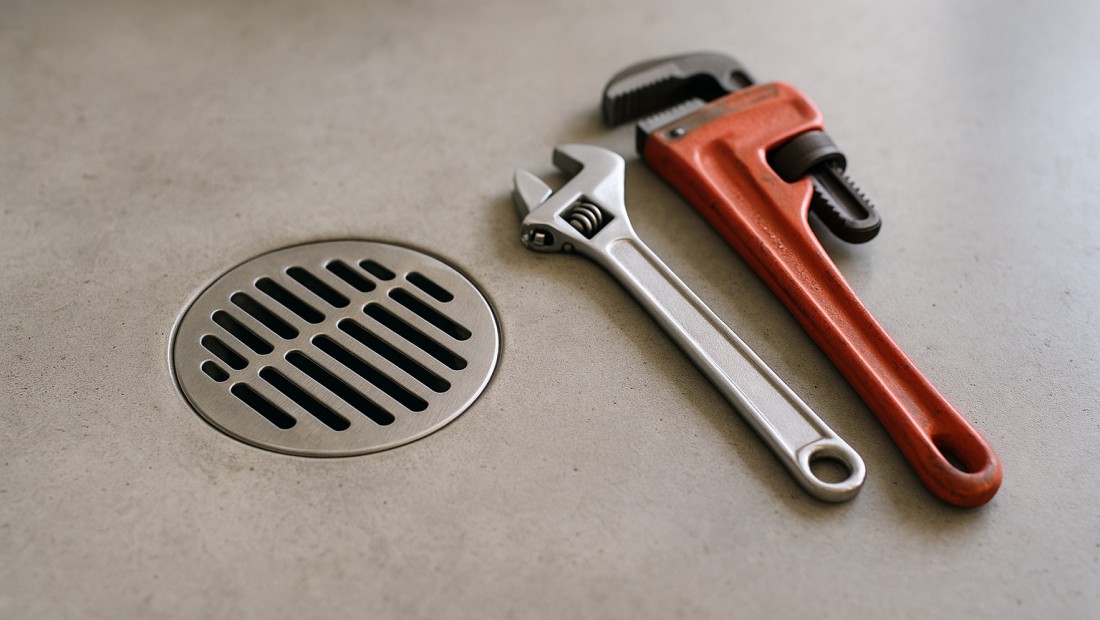
Floor drains are the quiet workhorses of a home — the round, grated drains in a garage, laundry room, utility area, or old basement that you never think about until water is pooling around them. Because they sit at the lowest point of the drainage system, they’re also the first place a backup shows up, which makes a clogged or overflowing floor drain an early warning worth heeding in New Orleans.
What floor drains do
A floor drain catches water that ends up on the floor — a washing-machine overflow, an air-conditioner condensate line, a water-heater leak, or wash-down water in a garage — and routes it into the drainage system. Like every drain, it has a trap: a curved section that holds a little water to block sewer gas from rising into the room. When that trap dries out (common for floor drains that rarely see water), sewer odor wafts up. When the drain or the line it feeds clogs, water backs up onto the floor instead of going down.
Why floor drains back up first
This is the key thing to understand about a floor-drain backup: the floor drain is usually not the problem. Because it sits lower than the sinks, tubs, and toilets in the house, it’s the path of least resistance when the main line backs up. So when wastewater comes up through a floor drain — especially if it’s dirty water and especially during heavy rain — the real blockage is almost always downstream in the building drain or sewer lateral, and the floor drain is simply where it surfaces. Clearing the floor drain itself won’t fix a main-line backup.
How a pro handles floor-drain problems
- Determine the cause. The tech figures out whether the floor drain itself is clogged or whether it’s backing up because the main line is.
- Clear a local clog. If the floor drain or its short branch is blocked with sediment, lint, or debris, a cable clears it directly.
- Clear the main if the backup is coming from downstream — cabling or jetting the building drain or lateral through a cleanout.
- Refill or repair the trap. For odor from a dry trap, simply adding water restores the seal; a damaged trap or missing trap primer may need attention.
The New Orleans floor-drain story
Floor drains matter more here than in higher, drier cities. With the water table high and the ground flat, water that gets onto a floor has nowhere convenient to go, so floor drains carry real duty — and when they fail, the water stays. During heavy rain, a floor drain is frequently the first fixture to back up as the system surcharges, which is exactly why it pays to know where your lowest floor drain is and to keep the main line that serves it clear. A floor drain that backs up every storm is telling you the lateral needs attention before the next one.
Odor from a floor drain
If a floor drain smells like sewer gas but isn’t backing up, the usual cause is a dry trap. Floor drains in low-traffic spots can go weeks without water, and the trap evaporates, breaking the seal that keeps gas out. The fix is as simple as pouring a quart of water (a little mineral oil on top slows evaporation) down the drain to refill the trap. If the smell persists after refilling, the issue may be a cracked trap, a missing cleanout plug nearby, or a venting problem worth having a pro check.
What floor-drain cleaning costs
Clearing a genuinely clogged floor drain or its short branch is a routine, affordable job. But because so many floor-drain backups are really main-line problems, the more relevant cost is often that of clearing the main — a larger job, and larger still if there’s no accessible cleanout. If your floor drain backs up repeatedly, the worthwhile spend is a camera inspection of the line it feeds, which will show whether you’re dealing with a simple clog or a lateral that needs cleaning or repair.