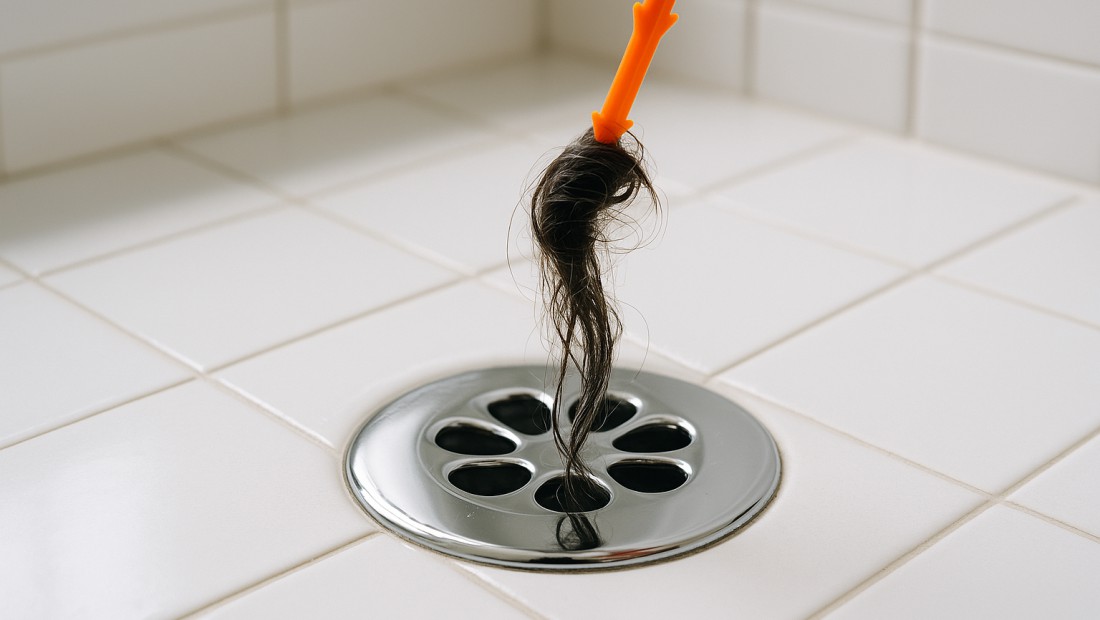
The bathroom is where most homeowners meet their first clog — a tub that drains slowly, a shower that pools around your ankles, a bathroom sink that gurgles and backs up. The cause is usually a familiar mix of hair, soap, and product, and the fix is straightforward, but a few New Orleans wrinkles make these drains worth understanding.
What clogs bathroom and shower drains
Bathroom clogs are almost always organic and built up over time. Hair is the anchor — it catches on any rough spot in the drain and forms a net. Soap scum, especially from bar soap, binds to the hair and to the pipe walls. Add conditioner, shaving residue, skin cells, and the occasional bottle cap or hair tie, and you get the dense, slimy mass that slows a shower to a crawl. Unlike a kitchen grease clog, which builds deep in the line, a bathroom clog often forms close to the drain opening, in the trap or just below it.
Bathroom sinks add their own ingredient: toothpaste, which combines with hair and soap into a stubborn plug right at the P-trap. And in older New Orleans homes, the original drain pipes are often narrow and rough-walled cast iron, which catches buildup more readily than smooth modern PVC.
How a pro clears a bathroom drain
- Pull the stopper or strainer. A surprising number of slow tubs and sinks are just a stopper mechanism choked with hair — the tech checks this first.
- Auger the trap. A hand auger or small drain machine reaches through the trap to grab and pull back the hair-and-soap mass rather than just pushing it deeper.
- Clear the branch. If the clog is past the trap, a slightly longer cable clears the branch line back to where it joins the main.
- Flush and verify. The tech runs water to confirm the drain empties at full speed, not just better than before.
Multiple bathroom drains slow at once
One slow shower is a local clog. But if the shower, the tub, and the bathroom sink are all sluggish together, the blockage is likely downstream where they share a branch — or, if a nearby toilet is also affected, in the main line itself. That distinction matters: clearing one fixture won’t solve a shared-branch or main-line problem, and it’s a sign to look further down the line with a camera.
Why old New Orleans bathrooms clog more
Two factors stack up in the city’s historic housing. The original drain pipes — cast iron in the early-twentieth-century homes, sometimes galvanized steel — corrode from the inside, leaving a rough, scaled interior that grabs hair and soap. And many of these homes have been remodeled in pieces over decades, so a modern walk-in shower may feed into an original drain line that was never sized or sloped for it. The result is a bathroom that clogs more often than its fixtures alone would suggest, which is where periodic cleaning — and, for badly scaled lines, jetting — earns its keep.
Preventing bathroom clogs
- Use a hair catcher over every shower and tub drain — it’s the single most effective prevention there is.
- Clean the stopper periodically; pull it and remove the hair that wraps around the mechanism.
- Flush with hot water after showers occasionally to help carry soap residue along.
- Don’t treat the toilet as a trash can — wipes, cotton, and floss belong in the bin, not the bowl.
What bathroom drain cleaning costs
A single slow tub, shower, or sink cleared by augering is among the least expensive drain calls. Cost rises if the clog is in a shared branch, if multiple fixtures are involved, or if a heavily scaled old line needs jetting rather than a quick auger. If your bathroom drains are chronically slow across the board, that’s usually the pipe itself, and a camera inspection will tell you whether cleaning will hold or the line is due for more.